
What We're Reading at W & E
- Winifred and Evalyn
- Mar 13
- 3 min read
At Winifred & Evalyn, we're immersed in the tactile world of textiles. Our focus is often on India, from block-prints and chinz to the art of stitching and crafting. To understand and appreciate the textiles we see and hold every day at W & E, we've begun delving into their fascinating history. It's not just the history of textiles, but the threads that connect our human story, society, and the language we use. Note: You can support small by ordering any one of these books from our friends at Artic Tern Books in Rockland, Maine

Threads of Life: A History of the World Through the Eye of a Needle — Clare Hunter (2019)
Overview: A global history of textiles told through stories of people, politics, and craft traditions.
Review: Hunter writes beautifully about embroidery, weaving, and textile traditions as expressions of identity and resistance. Although the book is global, several chapters explore South Asian textiles and their social meaning. It’s one of the most readable textile histories ever written, moving easily between personal stories, cultural history, and politics.
Why it’s special: You come away understanding that cloth is never just cloth: it’s memory, labor, and often power.
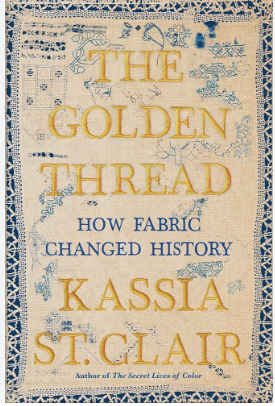
The Golden Thread: How Fabric Changed History — Kassia St. Clair (2018)
Overview: A sweeping history of fabrics and fibers across centuries.
Review: Each chapter focuses on a different textile: silk, cotton, denim, nylon, and tells the human story behind it. Indian cotton and dye traditions appear prominently because they were central to the global textile economy. Readers often describe it as “textile history written like a collection of fascinating essays.” This is a wonderful starting point to begin your dive into textile history.
Why it’s special: It explains how textiles shaped trade, fashion, and even politics.

Saris: Tradition and Beyond — Rta Kapur Chishti (2010)
Overview: A cultural exploration of the sari across regions of India.
Review: Part textile study, part cultural history, this book explores the sari not only as clothing but as a living cultural language. Chishti explains weaving traditions, regional drapes, and the symbolism behind fabrics. The writing is warm and accessible, and the stories behind different sari traditions bring the textiles to life.
Why it’s special: Few books capture the sari’s cultural richness so vividly.
How India Clothed the World — Giorgio Riello & Tirthankar Roy (2009)
Overview: A global history of Indian textiles and trade.
Review: This book reads almost like a historical adventure. It traces how Indian cottons and silks traveled across oceans and became some of the most desired fabrics in the world. For centuries, Indian textiles were central to global trade and cultural exchange.
Why it’s special: It reveals how India’s textile industry shaped the world economy.

Costumes and Textiles of Royal India — Ritu Kumar (1999)
Overview: A beautiful exploration of royal dress and historic fabrics.
Review: Written by designer Ritu Kumar, the book blends scholarship with storytelling. She traces courtly textiles: embroidered velvets, brocades, and muslins for example, through the histories of India’s royal courts. It feels less like a textbook and more like walking through a palace wardrobe.
Why it’s special: It brings together fashion, history, and royal culture.

Cloth That Changed the World: The Art and Fashion of Indian Chintz — Sarah Fee (2019)
Overview: The story of Indian chintz and its influence on global design.
Review: This book tells the remarkable story of printed cottons from India that captivated Europe in the 17th–18th centuries. The writing emphasizes the human story behind trade and craftsmanship, explaining how artisans, merchants, and colonial economies shaped textile history.
Why it’s special: It shows how a single textile tradition transformed global fashion.

The Golden Road: How Ancient India Transformed the World — William Dalrymple (2024)
Overview: A sweeping narrative history of India’s influence on global culture and trade.
Review: Although not strictly about textiles, Dalrymple describes the trade networks through which Indian ideas, art, and good (including fabrics) spread across Eurasia. The book explores a historical “Golden Road” linking India with the wider world.
Why it’s special: Dalrymple writes history almost like travel writing—immersive and vivid.

Textiles from Bengal: A Shared Legacy — Sonia Ashmore, Tirthankar Roy & Niaz Zaman (2026)
Overview: A cultural history of Bengal’s textile traditions.
Review: This new work explores Bengal’s extraordinary textile heritage (especially muslin and Baluchari weaving) and how colonial trade and industrialization nearly destroyed the industry. The book combines historical documents, maps, and stories from scholars and practitioners.
Why it’s special: It restores attention to a textile tradition that once “clothed the world.” We hope one or all of these books excite your interest in textiles and their importance in everyday life as well as our shared history.


Comments